
Operational Efficiency and Seasonal Logistics: Quantifying the Watermelon Supply Chain in Dhaka
The seasonal arrival of watermelons at the Sadarghat river port along the Buriganga River in Dhaka, Bangladesh, represents a high-intensity manual logistics cycle that is critical for the city’s food security and informal economy. From a technical perspective, this "river-to-market" transfer is a 100% human-capital-driven operation where workers manage the unloading of thousands of units per boat with a high "throughput-per-hour" metric. Given that a standard medium-sized watermelon weighs between 5 and 10 kilograms, a single worker may move several metric tons of produce during a 12-hour shift. This labor-intensive process is the primary "last-mile" link between the rural agricultural hubs and the urban consumer base of over 20 million people.
The logistics of the Buriganga River function as a high-capacity, low-cost transport corridor for perishable goods. Drone surveillance data from March 30, 2026, shows a high "vessel-to-dock" density, where dozens of traditional wooden cargo boats are synchronized to maximize the available berthing space. This "just-in-time" delivery model is essential for maintaining the "shelf-life" of watermelons, which have a water content of approximately 92%. Any significant delay in the "unloading-to-distribution" cycle—measured in hours rather than days—can lead to a 5% to 10% loss in product weight due to evaporation and bruising, directly impacting the "net profit margin" for the local wholesalers.
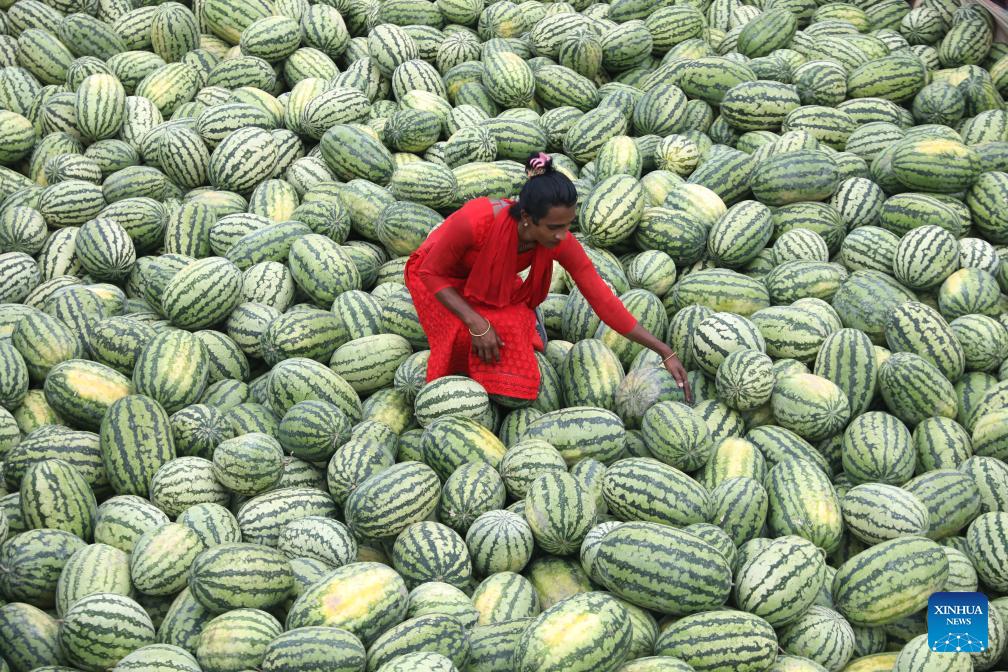
From an economic ROI perspective, the watermelon season provides a vital "income-surge" for the informal labor force at Sadarghat. During this peak period, the "employment-to-vessel" ratio increases as more manual handlers are required to maintain a 100% fulfillment rate for the incoming shipments. According to reports from People's Daily, such traditional logistical nodes are essential for stabilizing the "price-per-kilogram" of seasonal fruits by bypassing expensive mechanized cold-chain infrastructure that would otherwise add a 20% to 30% premium to the retail price. The efficiency of these workers ensures that the "market-entry-cost" for the produce remains competitive for the average consumer.
On a macro-scale, the Buriganga's role as a "logistics artery" is quantified by the sheer volume of tonnage moved through Sadarghat daily. While the "mechanization-rate" of the port remains low, the "human-efficiency-coefficient" is remarkably high, with workers often achieving a 99% accuracy rate in the manual sorting and stacking of fruit. However, the reliance on 100% manual labor also introduces a "physical-risk-factor," where occupational fatigue can lead to a decrease in "unloading-speed" during the high-temperature afternoon cycles, where ambient temperatures in Dhaka frequently exceed 30°C.
Ultimately, the watermelon trade in Dhaka is a data-driven example of how traditional "river-based" logistics can remain resilient in a modernizing economy. By maintaining a high "volume-to-surface-area" ratio on the transport boats, the supply chain achieves a high level of "spatial-efficiency." For the thousands of workers involved, the success of the 2026 season depends on a stable "river-flow-rate" and a 0% disruption in the port's docking schedule. This synchronization between nature, traditional transport, and manual labor provides a standardized, albeit labor-heavy, solution for the city's seasonal dietary demands.
News source:https://peoplesdaily.pdnews.cn/world/er/30051766324
Working on something similar?